
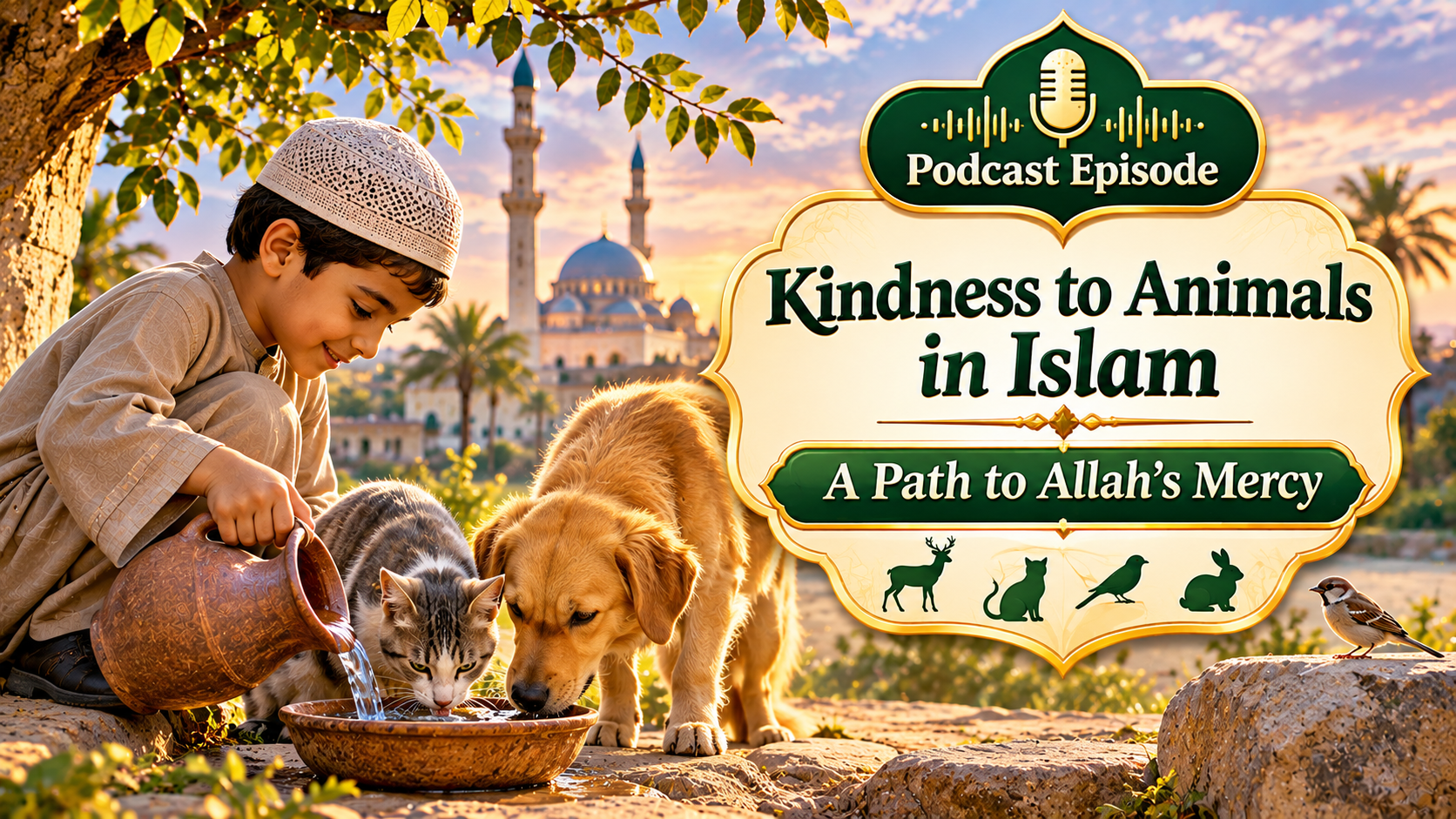
Emir: Halal County — where the questions are old, the answers are careful, and occasionally a thirsty dog changes everything.
Mariam: Today we’re covering a piece by Ahmed K. on one of the more searching questions in Islamic ethics: what our treatment of animals says about our faith, and why it carries real consequences.
Emir: Let’s start with the animals themselves.
Mercy Toward Every Living Creature
Mariam: The post opens with a claim that sets the frame for everything that follows: compassion in Islam is not reserved for human beings. Animals experience hunger, thirst, pain, and fear — and we are accountable for how we treat them.
Emir: And the Quran makes that accountability concrete. The post cites verse 6:38 directly: “And there is no creature on earth or bird that flies with its wings except that they are communities like you.”
Mariam: So the upshot is that animals aren’t background scenery — they’re recognized as having their own communities, their own ways of life. The verse reframes cruelty not as a minor lapse but as a violation against something that matters to Allah.
Emir: The post then brings in the hadith that makes the stakes visceral — a woman who imprisoned a cat, gave it neither food nor water, and blocked it from foraging. The Prophet’s words from Sahih al-Bukhari and Sahih Muslim: “A woman entered the Fire because of a cat which she had tied up, neither giving it food nor setting it free to eat from the vermin of the earth.”
Mariam: What the post draws out is the specific nature of the wrong. She wasn’t condemned for missing a grand act of worship. She caused deliberate suffering to a helpless creature that depended entirely on her.
Emir: The flip side arrives in two parallel stories — a man and a woman, both of whom gave water to a thirsty dog. The man climbed back down a well, filled his shoe, carried it up in his mouth. The Prophet’s conclusion, also from Sahih al-Bukhari and Sahih Muslim: “There is a reward for serving every living being.”
Mariam: The woman’s story adds another layer: she had committed serious sins. Her act of filling her shoe at a well for a suffering dog became the reason Allah forgave her. The post reads these two stories together as a message about hope — that no one should consider themselves beyond reach of mercy.
Emir: Three hadiths, one through line: the size of the creature does not determine the size of the consequence.
Mariam: The post extends this into daily practice. Feeding a stray cat, putting water out for birds in summer heat, planting a tree that animals eat from — all of these count as charity. And it closes with a direct appeal to parents: children learn mercy by watching it practiced, not by hearing it described.
Emir: Which brings the whole thing back to the opening claim — that kindness to animals isn’t peripheral to the faith. It’s a live expression of it.
Mariam: And that accountability runs in both directions: toward punishment for cruelty, and toward forgiveness for compassion.
Emir: Small acts, serious weight — that seems to be the recurring note.
Mariam: It is. And it’s a framework that keeps expanding outward — from the individual animal to the household to the community. Worth sitting with.


Leave a Reply