
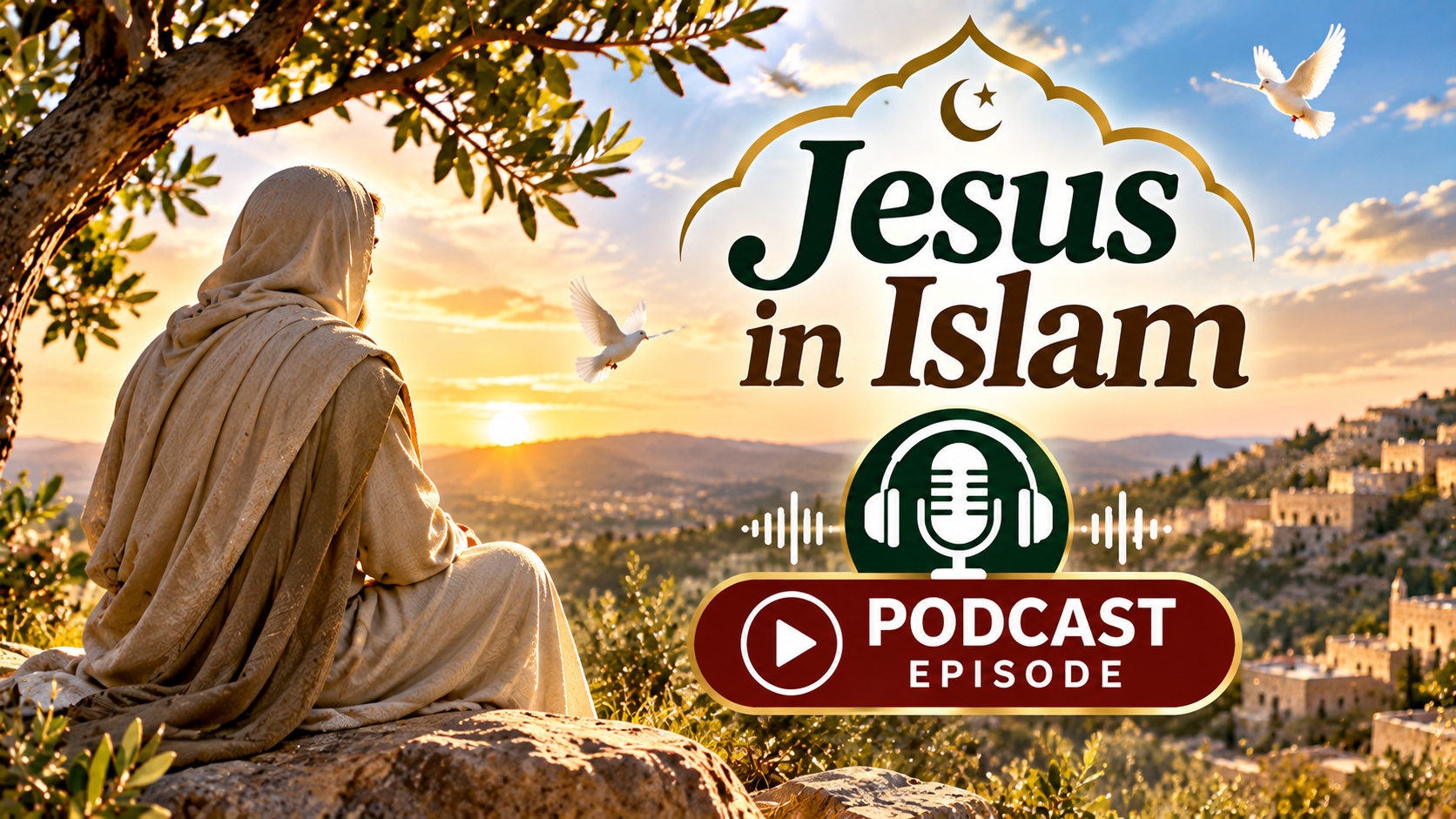
Emir: Welcome to Halal County — where the questions people whisper in interfaith small talk get answered out loud, in full paragraphs.
Mariam: Today’s episode comes from Amir E., and it goes deep on one subject: what Islam actually teaches about Jesus — his birth, his miracles, his place in the faith, and where Muslim and Christian belief converge and part ways.
Emir: More common ground than most people expect, and more precise distinctions than a bumper sticker could hold.
Mariam: Let’s start with who Jesus is in Islam, and what that means for how Muslims understand their own faith.
Jesus Through an Islamic Lens
Emir: The question at the center of this post is one that surprises a lot of people: does Islam have a Jesus? And the answer is not just yes — it’s that belief in Jesus is required for the faith to be complete.
Mariam: The post puts it plainly: “Belief in Jesus is an essential part of the Islamic faith, and we as Muslims honor him as a messenger of God.” That’s not a footnote — that’s a foundational claim.
Emir: So a Muslim who rejects Jesus as a prophet isn’t holding a stricter version of Islam. They’re actually outside the creed. That’s a significant thing for most non-Muslims to absorb.
Mariam: The post works through this carefully. Jesus — Isa in Arabic — was sent to guide the Children of Israel. His birth to the Virgin Mary, called Maryam, was miraculous: no human father, announced by the angel Jibril. The Quran compares that creation to Adam’s — no father, no mother — cited in Surah Al-Imran, chapter three, verse fifty-nine.
Emir: Which is a quietly elegant theological move. If you accept Adam, the logic goes, the mechanism for Jesus isn’t categorically different.
Mariam: Maryam herself holds remarkable standing. The post notes she is the only woman mentioned by name in the Quran, and an entire chapter — Surah Maryam — is dedicated to her story. The post calls her “one of the purest and most righteous women in human history.”
Emir: Then there are the miracles — healing the blind, curing leprosy, raising the dead, and forming a bird from clay that came to life. The list is striking. What the post is careful to add is the framing around it.
Mariam: Right — the Quran specifies these happened “by Allah’s permission,” not through any independent divine power. That distinction is doing a lot of theological work. It’s the post’s way of honoring the miracles while keeping the monotheism intact.
Emir: And on the crucifixion — the post names it as one of the sharpest divergences from mainstream Christian belief. Islam holds that Jesus was not killed or crucified, that Allah raised him, and that scholars have long discussed the details the Quran leaves open.
Mariam: The verse from Surah An-Nisa is direct: “they neither killed nor crucified Jesus, but Allah raised him to Himself.” The post doesn’t overreach — it acknowledges the Quran doesn’t fill in every detail.
Emir: And Jesus isn’t finished, in the Islamic view. He’s expected to return before the Day of Judgment — to defeat Al-Masih Ad-Dajjal, the false messiah, and restore justice. Not as a new prophet, but as a follower of the final message.
Mariam: The post closes on something worth sitting with: “The Messiah, son of Mary, was not but a messenger.” That’s Quran 5:75. The post frames Jesus as a genuine bridge — shared history, shared reverence, real theological difference — and argues that understanding the Islamic view reveals that Islam doesn’t reject Jesus at all.
Emir: It honors him. Just not in the way Christianity does — and the post is careful about that distinction throughout. Where the faith goes from here, in terms of daily practice, is its own conversation.
Mariam: What stays with me is the framing: honoring Jesus as a requirement of Islamic belief, not a concession to interfaith diplomacy.
Emir: The doctrine and the daily life of faith turn out to be more connected than they first appear. That thread runs through the next episode too.

Leave a Reply